
Mahindra BE 6 SPORTEQ Review: BaaS or Outright Purchase?
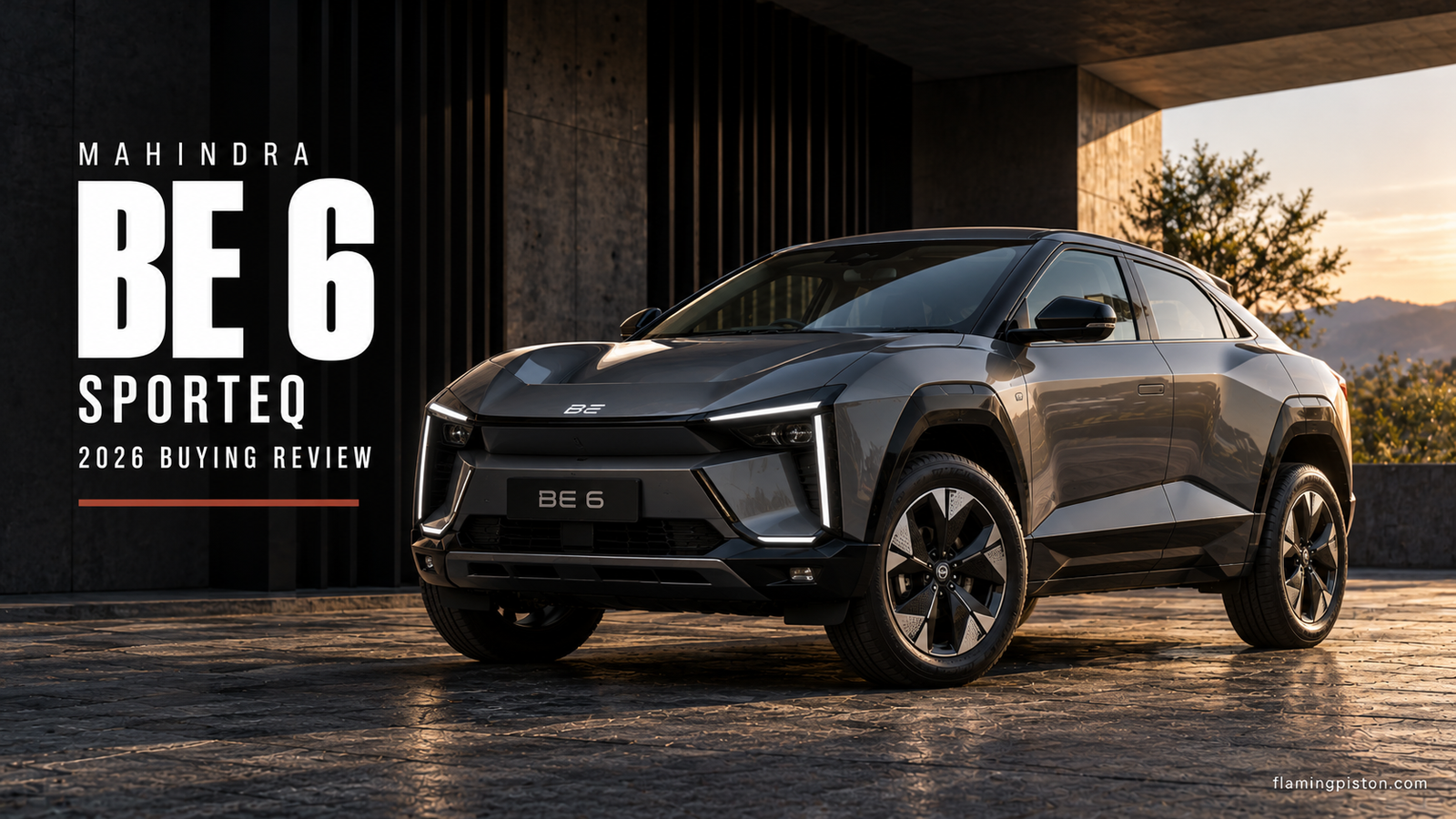
AI editorial illustration: FlamingPiston.
Desk-researched editorial review, checked 23 October 2026. FlamingPiston has not road-tested this vehicle for this article. Manufacturer claims and other publications’ driving findings are identified separately; the judgments and scores below are our editorial assessment.
The BE 6 SPORTEQ makes a convincing showroom impression before anyone discusses the battery agreement. That is precisely why the agreement needs attention. The striking body and ambitious cabin technology are real parts of the appeal, but an ₹11.45 lakh entry headline is not the same purchase as owning the battery outright. This EV needs to work as a car and as an ownership proposition.
Quick Verdict
A compelling choice for a driver who values performance and can charge conveniently. The rear-seat and visibility compromises make it less universal as a family recommendation. Compare outright and BaaS costs properly, and choose the pack for your journeys rather than the largest advertised range.
1
Price & Variants
Launch reference: ₹19.45 lakh outright**Ex-showroom, India. Price basis and limitations below.
| Variant / choice | Configuration / basis | Price reference |
|---|---|---|
| ONE 59 kWh, BaaS | Battery usage charged separately | ₹11.45 lakh at launch |
| ONE 59 kWh, outright | Battery purchase included | ₹19.45 lakh at launch |
| THREE 70 kWh, outright | Intermediate battery option | ₹22.95 lakh at launch |
| FOUR 79 kWh, outright | Upper specification | ₹26.95 lakh at launch |
Best Value Pick
THREE 70 kWh is our provisional balance of battery capacity and purchase cost, using the launch matrix. ONE 59 kWh remains the budget route for predictable local driving. These are Mahindra's 15 August announcement prices, excluding charger and installation, not guaranteed October transaction prices. Current secondary listings differ, so obtain the exact current configuration price before treating the gap as fixed.
2
Exterior Design
The BE 6's angular body has a clear identity. Our view is that the coupe-like profile and dramatic surfaces are a substantial part of why someone would choose it over a more conventional electric SUV. That earns a strong design assessment, but attractive proportions are not free of consequences.
The high tail and falling roofline also shape visibility and rear accommodation. A review that celebrates the exterior without discussing those effects has only done half the job.
3
Interior Design & Comfort
The Financial Express's August 2026 drive of the updated car reports a more open front cabin after the removal of the prominent curved divider. Its reviewer also found limited rearward visibility and a knees-up rear seating posture, with headroom constraints for taller occupants. Those are published observations, not our own drive impressions.
Our conclusion is that the improved front environment does not automatically make this a rear-seat-first family SUV. Buyers spending most of their time driving will judge the compromise differently from those regularly carrying tall adults behind them.
4
Features & Practicality
Mahindra specifies the three-screen dashboard from TWO upwards, while the Formula E Freedom version retains the two-screen cockpit. The base version should not be described using photographs of a more expensive cabin.
The software package includes digital-key and monitoring functions on applicable equipment. Their usefulness depends on compatibility and reliable everyday operation, which we have not tested. The feature score recognises the breadth of the offering while avoiding the assumption that every added function improves the driving experience.
| Specification | Published information |
|---|---|
| Battery choices | 59, 70 and 79 kWh, depending on variant |
| Drive layout | Single-motor rear-wheel drive |
| Price basis above | 15 August 2026 launch announcement |
| Excluded from announcement price | Wall charger and installation |
5
Performance & Mileage Potential
Autocar lists rear-wheel drive across the range and 231, 245 and 286 hp for the 59, 70 and 79 kWh versions respectively. That makes the battery decision partly a performance decision too. The Financial Express's updated-car drive praised the dynamics but criticised firmness on broken surfaces.
Autocar's SPORTEQ range page lists claims of 548, 651 and 683 km respectively. It separately reports 439 km city and 459 km highway for a tested 79 kWh version. These are that publication's results under its conditions, not a FlamingPiston guarantee or a result for the smaller packs.
BaaS also changes the cost of using that range. At the advertised ₹3.75/km rate, 1,000 km represents ₹3,750 before electricity or contractual adjustments. The lower upfront price is a financing and ownership choice, not proof of a lower lifetime bill. Minimum billing and exit terms need the actual agreement.
6
Tech & Safety Deep-Dive
Autocar's current equipment overview lists six airbags, stability control and available Level 2+ assistance. The BE 6 family has published Bharat NCAP protection evidence, but we have not independently established the applicability of that earlier result to every new SPORTEQ configuration. We do not label this a newly crash-tested SPORTEQ.
The safety score therefore recognises the listed equipment while remaining cautious about variant-level crash applicability. A large display and a capable assistance suite do not remove the need for good visibility, attentive driving and familiar controls.
How We Scored This
Using our Review Methodology, we assess the following eight criteria.
Each of the eight criteria carries equal weight. These are FlamingPiston editorial scores, not manufacturer ratings or the scores assigned by the publications consulted. The final average is rounded to one decimal place.
| Criteria | Score |
|---|---|
| Design | 9.0 / 10 |
| Performance | 8.5 / 10 |
| Mileage Potential | 8.0 / 10 |
| Comfort | 7.0 / 10 |
| Features | 9.0 / 10 |
| Safety | 7.5 / 10 |
| Practicality | 7.0 / 10 |
| Value for Money | 7.5 / 10 |
| Octane Score (average) | 7.9 / 10 |
Why These Scores
Design: Distinctive visual identity, with acknowledged packaging costs.
Performance: Strong listed outputs and positive published driving assessment.
Mileage Potential: Useful pack choices; reported independent range is below certification claims.
Comfort: Improved front openness, offset by reported ride and rear-seat limitations.
Features: Extensive cabin and software equipment, with variant restrictions.
Safety: Listed equipment credited; exact SPORTEQ crash applicability unresolved here.
Practicality: Rear seating, visibility and charging arrangements limit universality.
Value for Money: Promising pack choices, but current quote and battery contract govern value.
7
Verdict
Flaming Piston's Take
The SPORTEQ is most persuasive for the driver who actively wants its performance and design, has reliable charging, and accepts its rear-seat compromises. The 70 kWh version is our starting shortlist for mixed use; the 59 kWh remains relevant when regular trips are shorter. Buy the ownership arrangement you understand. The strongest part of this car should be the experience of using it, not the small number at the start of an advertisement.
Who Should Buy This
- Drivers wanting a distinctive performance-oriented EV with dependable charging access.
- Buyers able to compare battery subscription and outright ownership over their intended use.
Who Should Avoid This
- Rear-seat-first families regularly carrying tall adults.
- Buyers treating the BaaS headline as the complete purchase cost.
FAQs
Does the ₹11.45 lakh launch price include outright battery ownership?
No. It is the announced BaaS entry price; the August announcement quoted ₹19.45 lakh outright for ONE 59 kWh, excluding charger and installation. Current configuration pricing must be confirmed.
Are charger and installation included?
The announcement excludes the wall charger and installation from the quoted prices.
Have you measured SPORTEQ highway range?
No. This is a specification and ownership review, not a range test.
Related Reading
Sources: Mahindra Electric Origin SUVs; Autocar India; The Financial Express. Checked 23 October 2026. Publication findings are attributed in the text; specifications and availability depend on variant.
Back to reviews