
Volkswagen Virtus Review 2026: 1.0 TSI or 1.5 TSI?
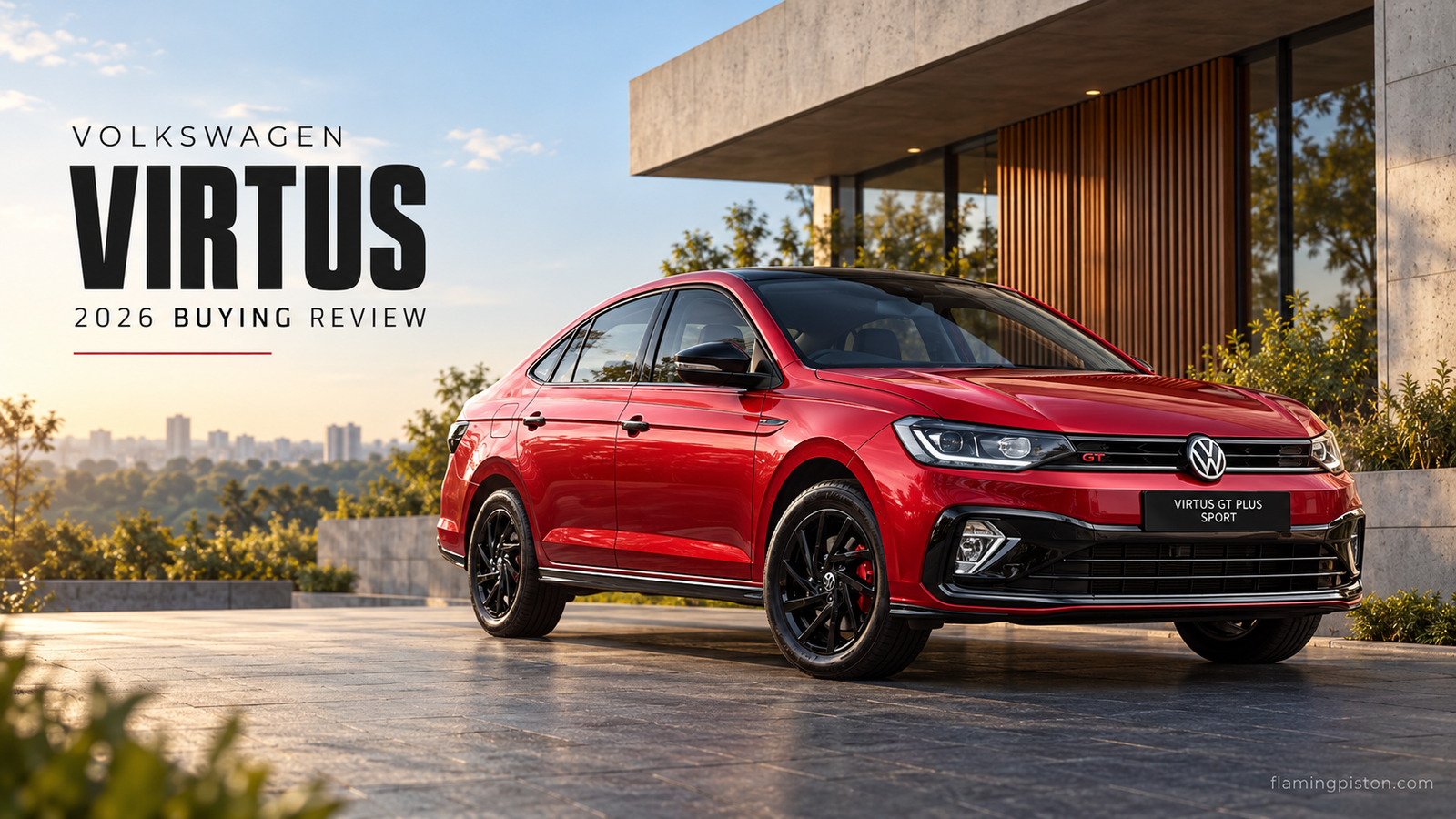
AI editorial illustration: FlamingPiston.
Desk-researched editorial review, checked 23 October 2026. FlamingPiston has not road-tested this vehicle for this article. Manufacturer claims and other publications’ driving findings are identified separately; the judgments and scores below are our editorial assessment.
The Virtus gives you two quite different reasons to buy a sedan. The 1.0 TSI is the everyday choice; the 1.5 TSI is the one that makes the engine a reason for choosing the car. Confusing the two is how a sensible shortlist turns into a very expensive trim upgrade. The badge may stay the same, but the bill and the performance proposition do not.
Quick Verdict
Choose the 1.0 TSI automatic for mixed city and highway use. Choose the 1.5 DSG because you want its extra performance and can justify the premium. The Virtus has a persuasive chassis and safety case; the top variant still needs to earn its price.
1
Price & Variants
From ₹10.71 lakh**Ex-showroom, India. Price basis and limitations below.
| Variant / choice | Configuration / basis | Price reference |
|---|---|---|
| Range entry | Entry configuration | ₹10,70,900 |
| GT Line 1.0 MT | 6-speed manual | ₹14,34,900 |
| GT Line 1.0 AT | 6-speed automatic | ₹15,24,900 |
| GT Plus Sport 1.5 DSG | 7-speed DSG | ₹19,19,900 |
Best Value Pick
GT Line 1.0 AT is our reference pick from this priced shortlist. At ₹15.25 lakh it gives the automatic buyer a much lower entry than the ₹19.20 lakh GT Plus Sport DSG. That gap includes trim differences as well as the engine, so it is not a pure engine surcharge. The 1.5 is the enthusiast recommendation, not the default value recommendation.
2
Exterior Design
The Virtus wears its sedan proportions confidently. It does not need a towering grille or a collection of fake off-road cues to create presence. Our design preference is for the cleaner versions: the long body and conventional three-box outline already do the work.
Volkswagen quotes 179 mm of ground clearance unladen. That is useful context for Indian roads, but it is not loaded clearance or permission to ignore a sharply crested speed breaker. Sedan proportions still come with sedan geometry.
3
Interior Design & Comfort
The appeal is a conventional passenger-car layout with a defined boot, rather than the tall seating position of an SUV. That is worth choosing deliberately. Buyers who prefer stepping into a high seat may find the body style less suitable regardless of the specification sheet.
Autocar India's assessment credits the Virtus with a well-controlled ride over poor surfaces. We treat that as published driving evidence, not our own test result. It strengthens the touring case, although passenger fit and the lower seating position remain personal considerations.
4
Features & Practicality
The useful distinction is between equipment you use and equipment that accompanies the engine you want. The GT Plus Sport's price should be justified by the whole package; choosing it simply because it is the most expensive Virtus is an unconvincing argument.
For an automatic buyer, the GT Line reference price leaves a substantial amount below the 1.5 DSG. That money matters more than a decorative upgrade if it keeps the purchase within a comfortable budget. This is why our features score is positive but our value verdict stops short of endorsing the top version for everybody.
| Specification | Published information |
|---|---|
| Official range entry | ₹10,70,900 ex-showroom at this check |
| 1.0 TSI | 115 PS; 178 Nm |
| 1.5 TSI | 150 PS; 250 Nm |
| Published ground clearance | 179 mm, unladen |
5
Performance & Mileage Potential
The 1.0 TSI makes 115 PS and 178 Nm; the 1.5 raises those figures to 150 PS and 250 Nm. That is a meaningful change in the engine's performance ceiling, not a sticker package. The 1.0 offers six-speed manual and automatic choices, while the 1.5 uses a seven-speed DSG.
Our 1.0 recommendation reflects cost and daily use, not a claim that it matches the 1.5 for pace. The larger engine is the more compelling choice if acceleration is central to the purchase. We have not timed either version.
Autocar's current listings report claimed efficiency of 20.19 km/l for the 1.0 manual, 18.7 for the 1.0 automatic and 19.62 for the 1.5 DSG. Treat these as laboratory comparisons. The apparent closeness does not guarantee similar fuel bills when the extra performance is used.
6
Tech & Safety Deep-Dive
Volkswagen lists six airbags as standard and cites five-star Global NCAP protection for adults and children. That published crash evidence gives the safety case more substance than a long equipment list alone. Ratings apply under their testing protocol and variant scope; they are not a promise that every collision has the same outcome.
Our safety score reflects that evidence. It is an editorial score out of ten, distinct from the crash-test body's stars. The two should never be presented as interchangeable numbers.
How We Scored This
Using our Review Methodology, we assess the following eight criteria.
Each of the eight criteria carries equal weight. These are FlamingPiston editorial scores, not manufacturer ratings or the scores assigned by the publications consulted. The final average is rounded to one decimal place.
| Criteria | Score |
|---|---|
| Design | 8.5 / 10 |
| Performance | 8.5 / 10 |
| Mileage Potential | 7.5 / 10 |
| Comfort | 8.0 / 10 |
| Features | 7.5 / 10 |
| Safety | 9.0 / 10 |
| Practicality | 7.5 / 10 |
| Value for Money | 7.5 / 10 |
| Octane Score (average) | 8.0 / 10 |
Why These Scores
Design: Clean sedan proportions and a clear visual identity.
Performance: Two useful engine levels; 1.5 output is a meaningful upgrade.
Mileage Potential: Competitive claims, without a measured result here.
Comfort: Published ride assessment supports touring comfort.
Features: Positive package, but the top trim is expensive.
Safety: Standard six airbags and published five-star Global NCAP result.
Practicality: Useful sedan layout; lower access and boot opening remain trade-offs.
Value for Money: 1.0 automatic is easier to justify than the top DSG.
7
Verdict
Flaming Piston's Take
The Virtus is easiest to recommend when the buyer still wants what a sedan offers: its proportions, driving position and road manners. Start with the 1.0 automatic and move to the 1.5 DSG for a clear performance reason. If that reason is missing, the cheaper car makes the stronger argument. If it is present, the extra engine is the most interesting thing you are buying.
Who Should Buy This
- Sedan buyers wanting published evidence of good ride control and crash protection.
- Drivers choosing the 1.5 specifically for its extra performance.
Who Should Avoid This
- Buyers who need high-seat access or a hatchback-style cargo opening.
- Anyone stretching the budget for GT Plus Sport without valuing the engine.
FAQs
What is the Virtus starting price at this update?
Volkswagen’s main model page listed ₹10,70,900 ex-showroom; confirm the current quotation for your variant.
How much more powerful is the 1.5 TSI?
Published outputs differ by 35 PS and 72 Nm compared with the 1.0 TSI.
Is this a hands-on Virtus road test?
No. It is a specification-based buying review checked on 23 October 2026.
Related Reading
Sources: Volkswagen India; Autocar India. Checked 23 October 2026. Publication findings are attributed in the text; specifications and availability depend on variant.
Back to reviews