
Skoda Slavia Facelift Review: Price, Specs & Features (2026)
By Gagan Mishra

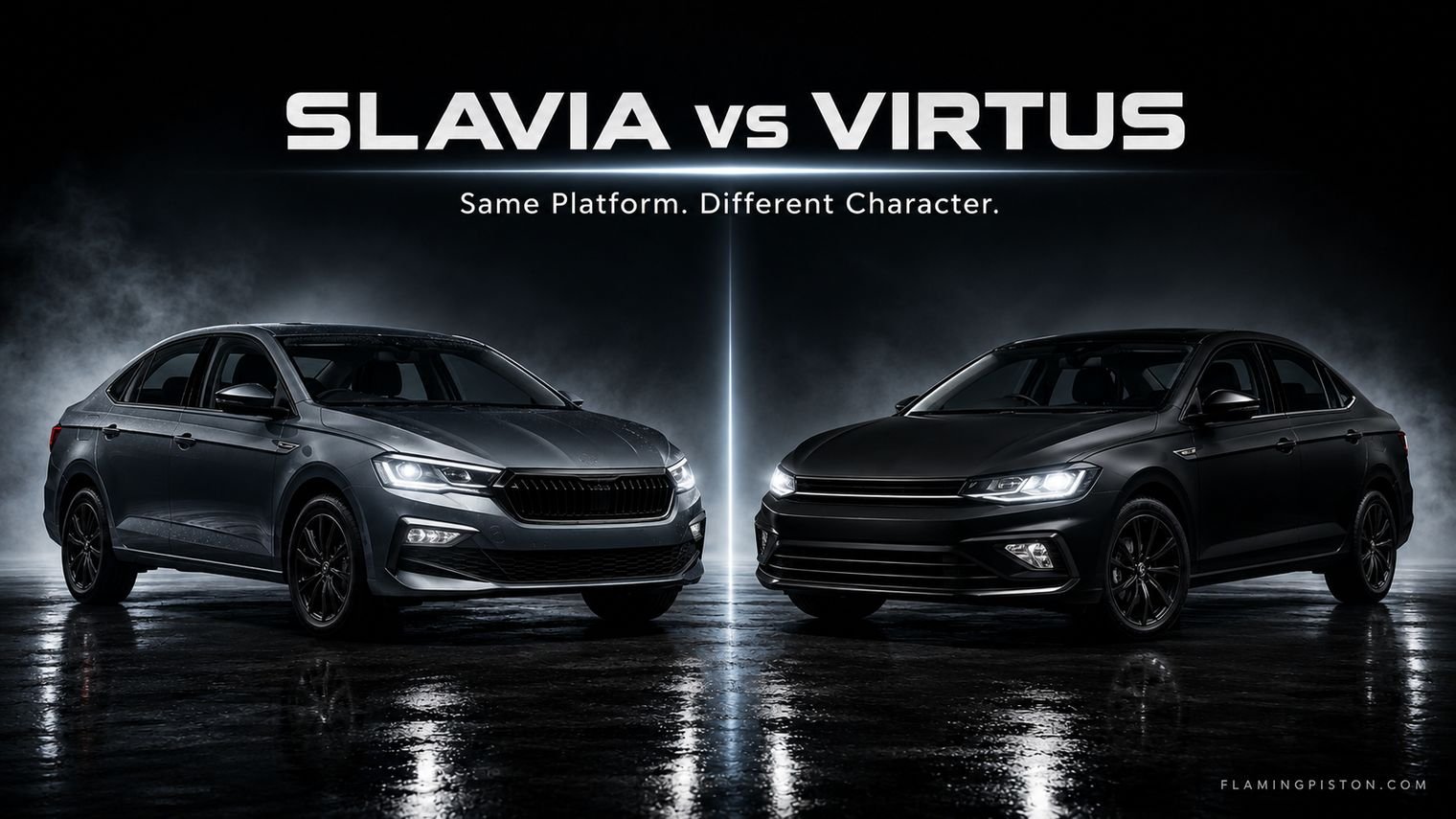
The Slavia and Virtus have always been an odd pair to cross-shop, because they aren't really rivals in the traditional sense — they're siblings. Both are built on Volkswagen Group's MQB A0 IN platform, developed together, and sold with nearly identical engines under two different badges. Normally that makes this comparison mostly about styling and brand preference. Today it isn't, because the Slavia just launched its facelift and picked up a genuine mechanical edge the Virtus doesn't have yet.
The Slavia facelift's 1.0 TSI automatic just moved to a new 8-speed torque converter, replacing the older 6-speed unit that reviewers consistently criticised for feeling hesitant in traffic. The current Virtus still runs that same older 6-speed automatic — its own facelift, expected later in 2026, will likely close this gap. If you're buying an automatic 1.0 TSI sedan today, that timing genuinely matters.
| Skoda Slavia Facelift | Volkswagen Virtus | |
|---|---|---|
| Starting price | ~₹11.00 – 12.00 Lakh* | ₹10.50 – 10.71 Lakh |
| Top-end price | ~₹18.00 – 19.00 Lakh* | ₹19.20 – 19.40 Lakh |
| Powertrains | 1.0 TSI, 1.5 TSI (petrol only) | 1.0 TSI, 1.5 TSI (petrol only) |
*Skoda hadn't published an official variant-wise price list at the time of writing — see our full Slavia facelift review for the latest update once confirmed. Based on pre-launch estimates, the Slavia will likely start slightly above the Virtus, which makes sense given the added equipment and the new gearbox. At the top end, the two have historically landed within a few thousand rupees of each other, and there's no reason to expect that to change here.
This is the part most comparisons undersell. Both cars share the MQB A0 IN platform, both offer a 1.0-litre TSI turbo-petrol and a 1.5-litre TSI turbo-petrol, and the outputs are close enough to be a rounding error apart.
| Engine | Slavia Facelift | Virtus |
|---|---|---|
| 1.0 TSI Power / Torque | ~115-116 PS / 178 Nm | ~115 PS / 178 Nm |
| 1.0 TSI Automatic | New 8-speed torque converter | 6-speed torque converter |
| 1.5 TSI Power / Torque | ~150 PS / 250 Nm | ~150 PS / 250 Nm |
| 1.5 TSI Automatic | 7-speed DSG | 7-speed DSG |
| Boot Space | 521 litres | 521 litres |
The 1.5 TSI DSG combination is a genuine tie between them — same engine, same gearbox, same tuning philosophy. The only place they currently diverge mechanically is the smaller engine's automatic, where the Slavia facelift's new 8-speed unit has a real, tangible edge over the Virtus's carried-over 6-speed until Volkswagen's own facelift arrives. Worth noting: Volkswagen has already discontinued the manual gearbox on the Virtus's 1.5 TSI, so if you want a manual with the bigger engine, neither car currently offers it, but the smaller 1.0 TSI keeps a manual option on both.
| Powertrain | Slavia Facelift (outgoing figures) | Virtus |
|---|---|---|
| 1.0 TSI Manual | ~20.32 km/l | ~20.19 – 20.80 km/l |
| 1.0 TSI Automatic | Not yet confirmed for the new 8-speed | ~18.70 km/l |
| 1.5 TSI DSG | ~18.73 km/l | ~19.62 km/l |
These figures are close enough that mileage shouldn't be your deciding factor either way. Skoda hasn't confirmed whether the new 8-speed automatic changes the Slavia's 1.0 TSI automatic figure from its outgoing 6-speed number — we'll update this once official ARAI figures are out.
The current Virtus holds a confirmed 5-star Global NCAP rating with six airbags standard. The outgoing Slavia held the same 5-star Global NCAP rating and was marketed by Skoda as India's safest family car, but the facelifted Slavia had not been independently crash-tested at the time of its launch. That's not a knock on the facelift specifically, crash-test ratings simply take time to catch up with new models, but it does mean the Virtus currently has the paperwork to back up its safety claim and the Slavia facelift doesn't, yet.
Both cars offer wireless Android Auto and Apple CarPlay, ventilated seats on higher trims, and a similarly laid-out dashboard, which isn't surprising given the shared platform. The Slavia facelift's 10.24-inch digital driver's display — confirmed exclusive to the Prestige and Monte Carlo trims, with lower variants keeping an 8-inch cluster — is a genuine step up from the Virtus's current cluster on those top trims specifically. Pre-launch reporting had speculated Level 2 ADAS might arrive with the facelift; it didn't. Neither car currently offers it, so that's a wash rather than a Slavia advantage.
Both brands operate under the same Skoda Auto Volkswagen India umbrella and share a substantial amount of parts and service infrastructure, even though showrooms and service bookings are still handled separately by brand. In practice, this means neither car has a meaningfully wider or narrower service reach than the other in most Indian cities. The real difference is brand character rather than ownership cost: Volkswagen leans into "German engineering" positioning, while Skoda has built its India reputation more specifically around safety credentials and value-for-spec. Neither is objectively right, it's a genuine personal-preference call.
If you're buying today and want the 1.0 TSI with an automatic gearbox specifically, the Slavia facelift's new 8-speed unit gives it a real, current advantage over the Virtus's older 6-speed. If you want the 1.5 TSI DSG, this comparison is close to a coin flip; mechanically they're the same car, so it comes down to styling, brand preference, and whichever dealer treats you better. And if a confirmed, independently-verified crash-test rating matters to you right now rather than "should be equivalent," the Virtus currently has the paperwork and the Slavia facelift doesn't, yet. Worth remembering: Volkswagen's own Virtus facelift is expected later in 2026 and will likely close most of these gaps, so if you can wait, it's worth watching for.
Are the Skoda Slavia and Volkswagen Virtus the same car underneath?
Mechanically, very close. Both are built on the shared MQB A0 IN platform and use the same 1.0-litre and 1.5-litre TSI turbo-petrol engines, with matching outputs and a shared 521-litre boot.
What is the real difference between the Slavia facelift and the Virtus right now?
Timing. The Slavia facelift's 1.0 TSI automatic just moved to a new 8-speed torque converter, while the current Virtus still uses the older 6-speed unit until its own facelift arrives later in 2026.
Which is cheaper, the Slavia facelift or the Virtus?
Pre-launch estimates put the Slavia facelift's starting price around ₹11-12 lakh, slightly above the current Virtus's roughly ₹10.50-10.71 lakh starting price. Confirm both against official price lists before deciding, since the Slavia's final pricing wasn't out at the time of writing.
Is the Virtus facelift coming too?
Yes. Volkswagen's own Virtus facelift has been reported for later in 2026, expected to bring similar updates to what the Slavia just received, including a likely gearbox upgrade.
Which is safer, Slavia or Virtus?
The current Virtus holds a confirmed 5-star Global NCAP rating. The outgoing Slavia held the same rating, but the facelifted Slavia had not been independently crash-tested at the time of its launch, so its own rating is still pending.
Do Skoda and Volkswagen share service centres in India?
The two brands operate under the same Skoda Auto Volkswagen India umbrella and share significant parts and service infrastructure, though showrooms and service points are still branded and booked separately.
More on the Slavia: Full Facelift Review · Launch News
By Gagan Mishra
By Gagan Mishra